


Are you dying to know if 10-OH-HHC is legal in Germany? To put it simply: Yes, as things stand, buying and possessing 10-OH-HHC is completely legal. Unlike its well-known relative, HHC, which was recently banned, 10-OH-HHC is currently neither on the list of prohibited substances under the New Psychoactive Substances Act (NpSG) nor on the list under the Narcotics Act (BtMG).
A quick overview of the legal situation of 10-OH-HHC
Imagine German drug laws like a high-tech scanner at the airport. This scanner is precisely programmed to recognize specific molecular structures and raise an alarm. With the HHC ban, the scanner was recalibrated to filter out an entire family of substances. However, 10-OH-HHC has a kind of "false beard"—its unique chemical structure is just different enough to slip through this legal net undetected.
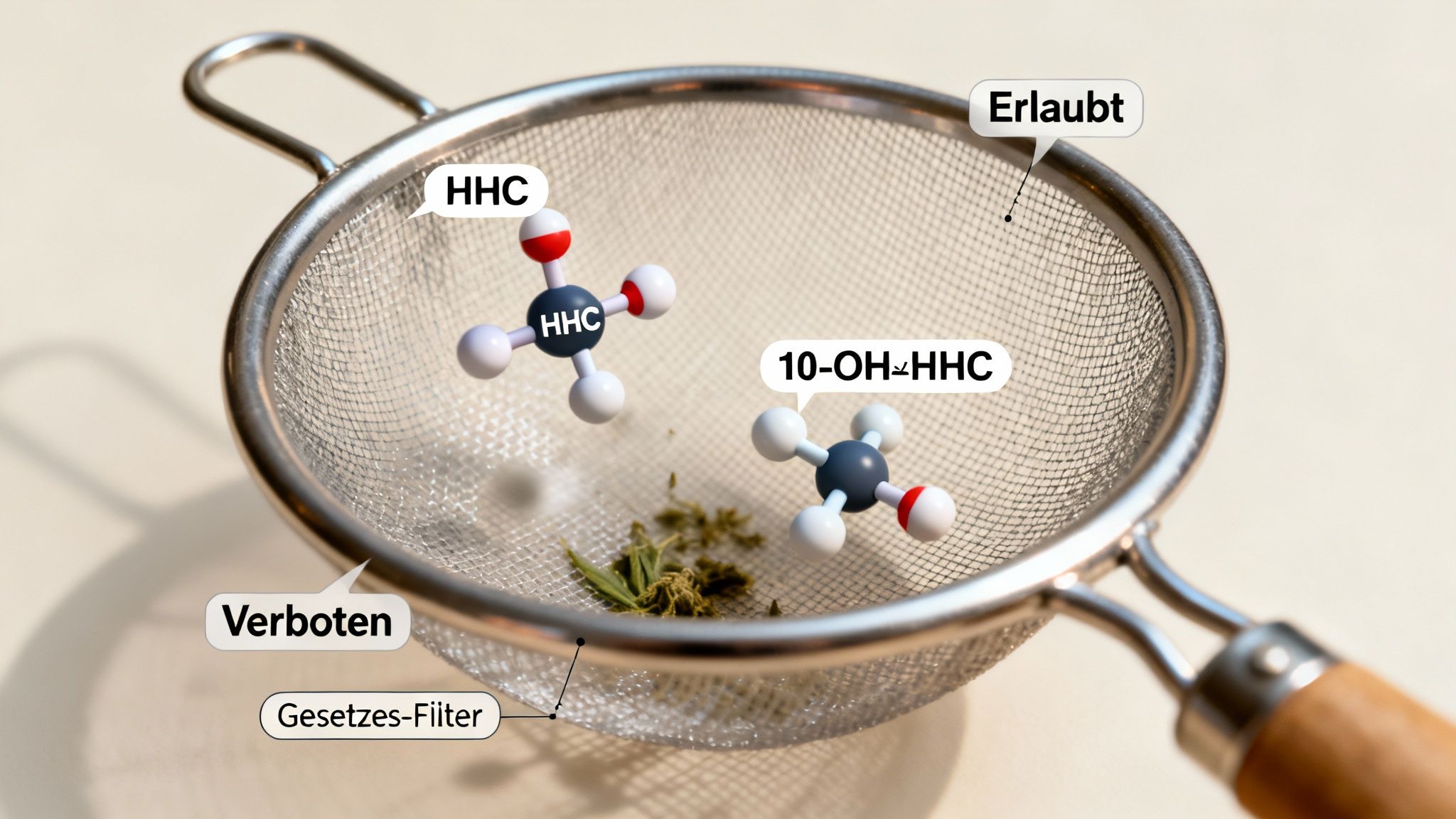
This legal loophole is precisely why you can buy 10-OH-HHC today without any worries. We'll give you a quick overview here, without overwhelming you with a stack of legal paragraphs.
Why HHC was banned and 10-OH-HHC (still) isn't.
There was a day that completely reshuffled the rules of the game for cannabinoids in Germany. On that day, the New Psychoactive Substances Act (NpSG) was tightened, making HHC and a whole host of similar substances illegal at a stroke. But 10-OH-HHC, which, ironically, is a metabolic product your body produces from HHC itself, escaped the ban. Why? Its chemical structure—with the hydroxylation at the 10th carbon atom—simply doesn't fall under the definition of the law.
The devil, as so often, is in the molecular details. The laws prohibit very specific chemical skeletons. However, the small hydroxyl group at position 10 of the 10-OH-HHC molecule modifies this skeleton just enough to remove it from the list of prohibited substances.
For you as a customer, this means: You're currently on the safe side, but the situation can change. The cannabinoid market is extremely dynamic. That's precisely why suppliers like MYGREEN place so much emphasis on absolute transparency and rigorous quality controls.
To make things even clearer, here's a direct comparison:
Legal situation at a glance: 10-OH-HHC vs. HHC
This table shows at a glance where the journey has led for both substances in Germany and why they are treated so differently under the law.
| feature | 10-OH-HHC | HHC (Hexahydrocannabinol) |
|---|---|---|
| Current legal status | Legal | Illegal (since July 2023) |
| Entry in the NpSG | No, not recorded | Yes, explicitly recorded |
| Entry in the Narcotics Act | No | No |
| Chemical structure | Hydroxylated variant | Hydrogenated variant |
| Availability | Legally available for purchase | Illegal, trade prohibited |
The difference could hardly be clearer. While HHC is clearly on the sidelines, 10-OH-HHC currently has a clear path.
What this means for you now
This legal situation is your chance to explore the world of cannabinoids in a safe and legal way. Instead of relying on dubious sources from the black market, you can opt for lab-tested products from reputable dealers. The legality of 10-OH-HHC perfectly demonstrates how quickly and creatively the market for legal highs adapts to new circumstances.
Here are the most important facts for you in a nutshell:
- Currently legal: The purchase, possession and consumption of 10-OH-HHC are currently not punishable offenses in Germany.
- Chemical trick: The molecular structure differs significantly from that of the banned HHC.
- No entry in the legal code: It appears neither in the NpSG nor in the BtMG.
With this knowledge, you are well prepared. In the following sections, we will delve deeper into the details of the laws, potential risks, and the characteristics of safe products.
A look at the law book: Why HHC was banned and 10-OH-HHC is allowed to stay.
To understand why 10-OH-HHC is legal, we need to take a brief but fascinating detour into the German legal jungle. The big question is: Why has HHC been banned, while 10-OH-HHC is still happily playing along? The answer lies hidden in two important laws: the New Psychoactive Substances Act (NpSG) and the venerable Narcotics Act (BtMG) .
Imagine the NpSG as the bouncer of a pretty trendy club. This bouncer doesn't have a guest list with names on it. Instead, he has a very clear instruction: "No white sneakers, no caps." Anyone who shows up dressed like that won't get in—no matter who they are.
The New Psychoactive Substances Act (NpSG) works precisely on this principle with its substance group bans . Instead of laboriously naming each new substance individually, the law simply defines certain basic chemical structures. If a molecule fits into this framework—that is, if it essentially has "white sneakers"—it is automatically banned. Just like that, the door is closed.
The NpSG as a chemical gatekeeper
And that was precisely the problem for HHC. Its chemical structure fit perfectly into one of the prohibited substance groups. Once lawmakers realized this, HHC's fate was sealed. The gatekeeper recognized it by its structure and denied it access to the legal market.
Now comes the trick with 10-OH-HHC: it's essentially wearing the "wrong shoes" for the club. A tiny but crucial change to its structure—the attached hydroxyl group at the 10th position —means it no longer fits the NpSG template. The gatekeeper looks at it, shrugs, and waves it through. It simply isn't detected by the system.
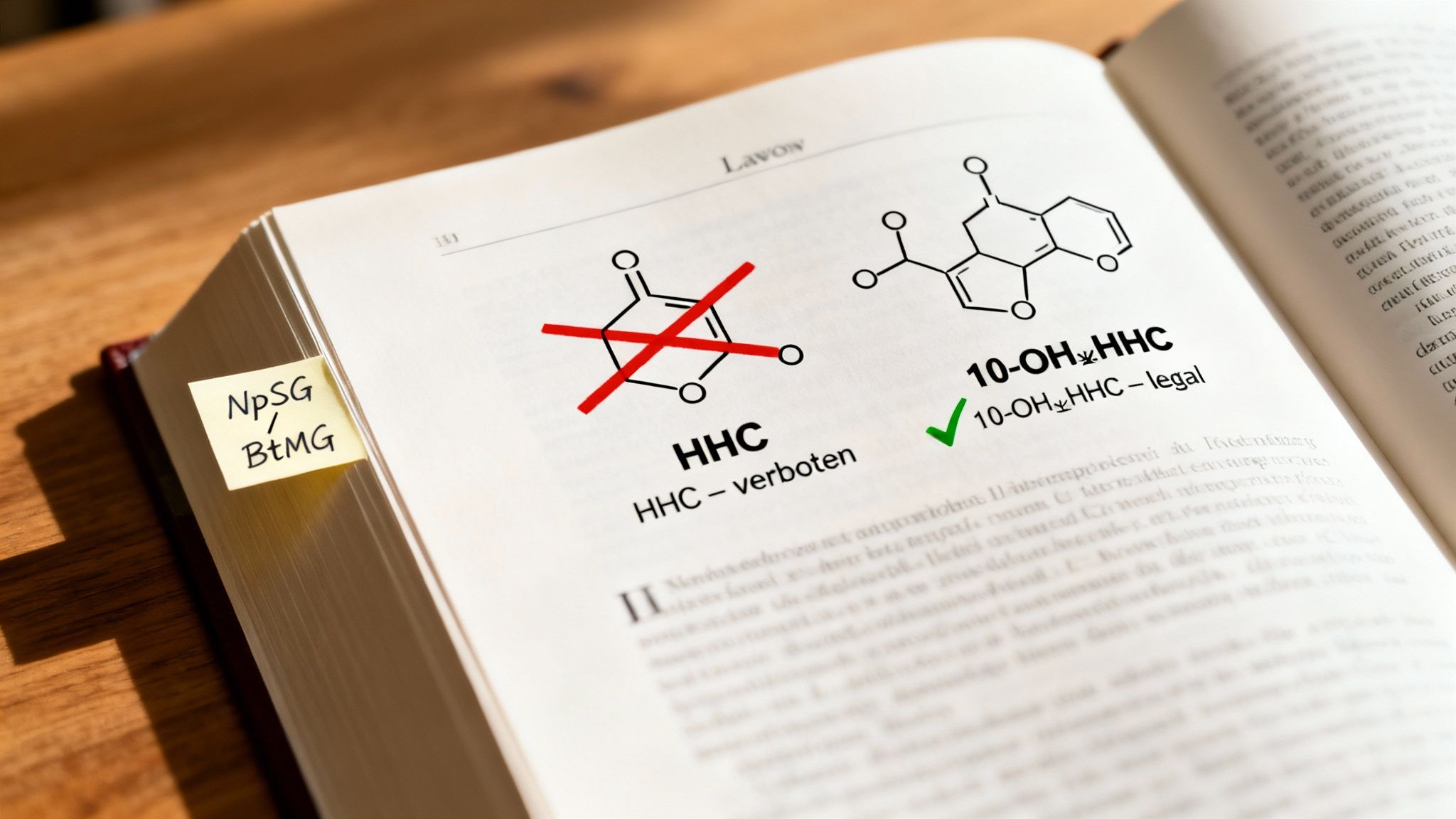
It is precisely this chemical subtlety that allows 10-OH-HHC to slip through the cracks of current regulations.
Why 10-OH-HHC is not listed in the German Narcotics Act (BtMG).
Besides the modern New Psychoactive Substances Act (NpSG), there is also the Narcotics Act (BtMG). This is, so to speak, the "hall of shame" for prohibited substances. It contains the biggest names like cannabis (THC), cocaine, and heroin. To be included here requires considerable patience and a host of scientific reports.
The German Narcotics Act (BtMG) is a list of names. A substance only ends up there if its potential for danger and addiction has been proven beyond doubt. For 10-OH-HHC, such an assessment simply does not yet exist.
This process can drag on for years. A solid database is needed, which simply doesn't yet exist for a cannabinoid as new as 10-OH-HHC. As long as there is no concrete evidence of a significant health risk, the door to the "hall of shame" for 10-OH-HHC will remain firmly closed.
The legal situation can therefore be summed up very simply:
- Loophole in the NpSG: Due to its special molecular structure, 10-OH-HHC does not fall under the general substance group prohibitions.
- No entry in the German Narcotics Act (BtMG): It is not listed by name as a prohibited narcotic because the necessary tests and data are lacking.
This interplay of chemical details and bureaucratic processes is the reason why you can currently legally buy 10-OH-HHC, while its predecessor is long gone. It's a perfect example of how a tiny molecular change can have a huge legal impact. For you as a customer, this means you're currently in the clear.
The cat-and-mouse game surrounding HHC & Co.
The current legality of 10-OH-HHC is no accident. On the contrary, it is the direct result of a rapid race between resourceful manufacturers and European legislators – a real cat-and-mouse game that has thoroughly shaken up the cannabinoid market.
To understand why the question "Is 10-OH-HHC legal?" is answered with a resounding "yes" today, we need to take a brief look back. It all started with the explosive rise of HHC. Suddenly it was everywhere, a veritable gold rush. The problem? The market was flooded with products that often lacked any quality control or safety certifications.
This, of course, did not go unnoticed for long. The European Monitoring Centre for Drugs and Drug Addiction (EMCDDA) sounded the alarm early on. Their warning was unequivocal: We have a completely unregulated market here, where even minors have access to potent, untested substances. In Germany, political pressure grew to finally put an end to this legal gray area.
The path to the inevitable ban
The Federal Ministry of Health reacted and worked feverishly on a solution. The goal was quite clever: they wanted not only to ban HHC, but also to directly prevent the next, chemically slightly modified molecule from immediately taking its place. The solution was found in a clever amendment to the New Psychoactive Substances Act (NpSG) .
Instead of banning just a single substance, an entire modular system of chemical structures was criminalized. Ultimately, the Federal Council approved this update to the New Psychoactive Substances Act (NpSG), effectively putting a stop to HHC and a whole range of related cannabinoids. This historic moment is key to understanding why the market even sought alternatives in the first place.
The ban on HHC was not the end of the story, but rather the starting point for a new wave of innovation. The market reacted with lightning speed, producing substances that cleverly circumvented the new legal definitions – and 10-OH-HHC was at the forefront of this development.
This cat-and-mouse game between innovators and legislators is, incidentally, not a new phenomenon. Years earlier, the EMCDDA warned of the HHC hype, which led to even 18-year-olds being able to buy legal products without quality control – resulting in an increase in poisoning cases. The Federal Council's response with the NpSG update was comprehensive, banning entire classes of substances and imposing strict penalties for everything from production to export.
And what about 10-OH-HHC? As a hydroxy metabolite, it cleverly breaks the mold: it's precisely the substance the body produces itself when metabolizing HHC. According to many user reports, this could even lead to a more intense effect, since the conversion step in the body is essentially skipped. You can find more fascinating details about the HHC ban in this comprehensive article about the background .
How transparency is changing the market
This entire development had a crucial side effect: it quickly separated the wheat from the chaff. While some shady players tried to flood the market with the next unregulated substance, responsible providers like MYGREEN pursued a different path from the outset. We quickly realized that in an uncertain environment, trust is the most valuable asset.
Therefore, comprehensive laboratory certificates were a matter of course for us, long before legislators even required them for the products we now carry. This focus on safety and transparency was our answer to the chaos and clearly distinguished us from disreputable suppliers. For us, it was therefore a logical consequence to remove HHC products from our range and focus entirely on safe, legal alternatives.
This background story clearly demonstrates one thing: the legal situation is never set in stone. It is the result of a constant dance between innovation, regulation, and consumers' desire for safe, legal alternatives.
What you as a buyer and seller really need to pay attention to
Even though 10-OH-HHC is currently legal, that doesn't mean every purchase and sale is completely risk-free. The legal situation in Germany seems clear at first glance, but there are a few nasty pitfalls lurking in the fine print for both consumers and retailers. Those who know the rules of the game can easily navigate around them.
The biggest danger for you as a customer lies less in the law and more in the product itself. The market for new cannabinoids is the Wild West – unregulated and full of adventurers. Unfortunately, this also attracts suppliers who aren't too concerned with quality. A temptingly low price can quickly turn into an expensive trap for your health.
Untested products from dubious sources are like a grab bag from hell. You never know what you're going to get. In the worst-case scenario, your vape contains not only the hoped-for 10-OH-HHC, but also an unappetizing chemical cocktail that has absolutely no business being there.
The hidden dangers for consumers
Think of producing cannabinoid distillates like cooking a complicated meal. If the cook is sloppy or uses cheap, spoiled ingredients, it won't just taste terrible, it can also seriously upset your stomach.
The situation is very similar in the production of 10-OH-HHC. If the chemical processes are not carried out under the strictest laboratory conditions and by true professionals, dangerous residues can lurk in the final product.
- Solvent residues: Solvents like ethanol or heptane are often used in production. If these aren't completely removed, you'll inhale them. That's not exactly appetizing.
- Heavy metals: If the hemp plant grows on contaminated soil, it absorbs heavy metals such as lead or mercury like a sponge. These then end up in highly concentrated form in the finished distillate.
- Pesticides: Even sprays from cultivation can survive the entire way to the finished product and wait for you there.
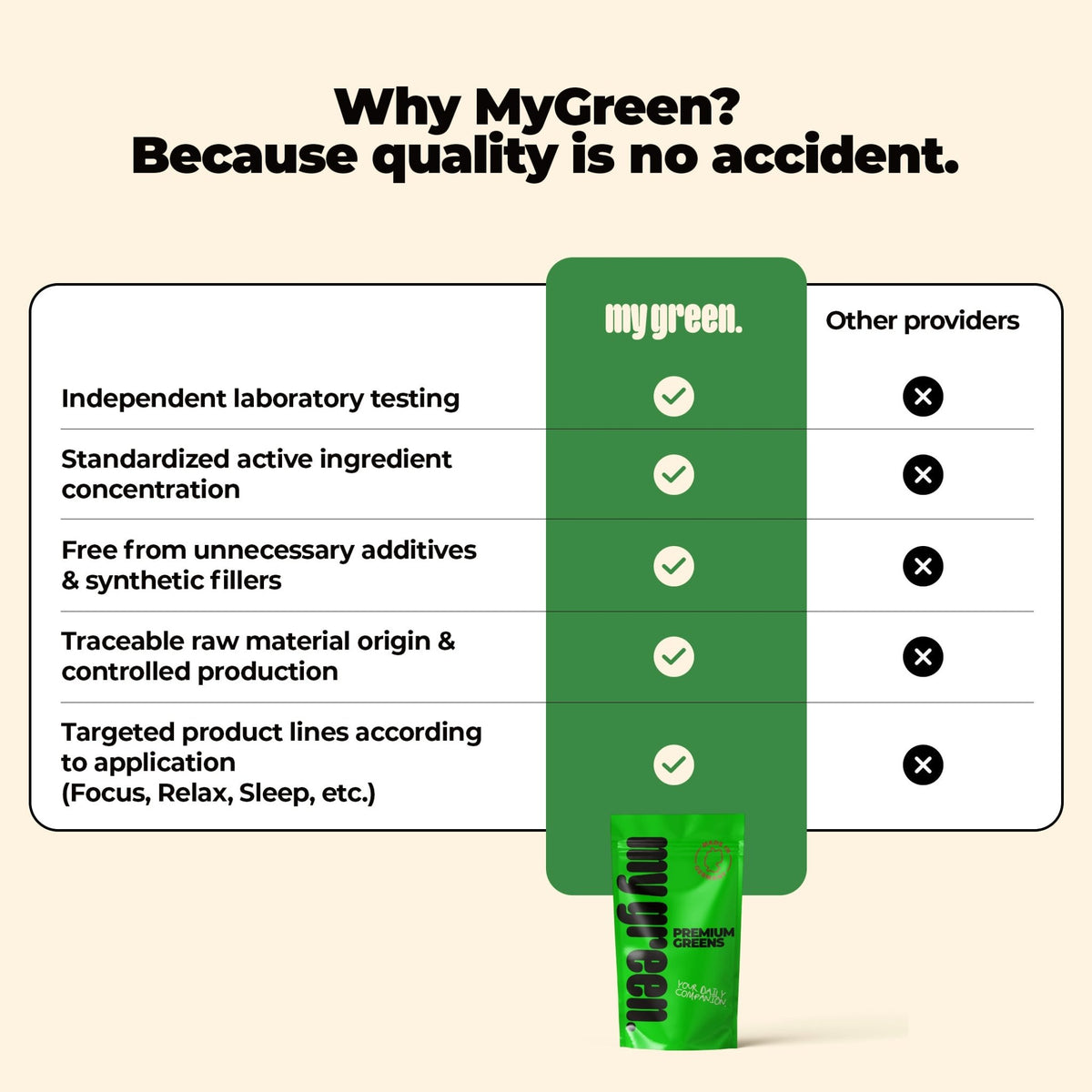
Such contaminants can cause anything from headaches and nausea to truly nasty long-term health problems. That's precisely why it's so incredibly important to only buy from suppliers like MYGREEN, who have every single product thoroughly tested by independent laboratories and openly show you the certificates.
Legal pitfalls for retailers
For dealers, the situation is somewhat different. Here, it is primarily the legal uncertainty that is causing sleepless nights. Even though 10-OH-HHC is currently not subject to either narcotics or new psychoactive substances legislation, authorities could try to stop its sale through other means.
A product can be legally classified as an "unsafe food" or even a "questionable drug." Such a classification can lead to immediate sales bans, confiscation of all goods, and substantial fines.
This risk can cost a retailer their livelihood. One wrong move, and the whole business is shut down. Reputable suppliers minimize this risk through comprehensive documentation, the highest product purity, and clear labeling that avoids making wild health claims. They navigate the gray areas carefully and respectfully, rather than blindly exploiting them.
The explosive growth of the market for semi-synthetic cannabinoids has naturally also alarmed the authorities. The Federal Criminal Police Office (BKA) has identified a significant increase in drug-related offenses in its narcotics report, directly linked to the boom in substances like HHC. Before HHC was banned, trade flourished on numerous darknet platforms. 10-OH-HHC, as a legal alternative, has benefited from this; industry experts estimate its market share at 15–20 percent among new cannabinoids. The BKA's analysis impressively demonstrates the rapid development of this market.
What does this mean for you? Quite simply: A dealer who openly discusses their strategies and doesn't hide their lab analyses is a significantly safer bet. This demonstrates that they understand the risks and actively manage them. While the legality of 10-OH-HHC protects you from the police, only a certified and transparent supplier protects you from health risks. Read our guide on the effects and experiences with 10-OH-HHC to make a truly informed decision.
How to recognize safe and legal 10-oh-hhc products
Now for the practical stuff! The 10-OH-HHC market is a real jungle. New offers are popping up everywhere, but how do you separate the good ones from the bad ones? Don't panic, we have a foolproof guide for you to put every supplier to the test.
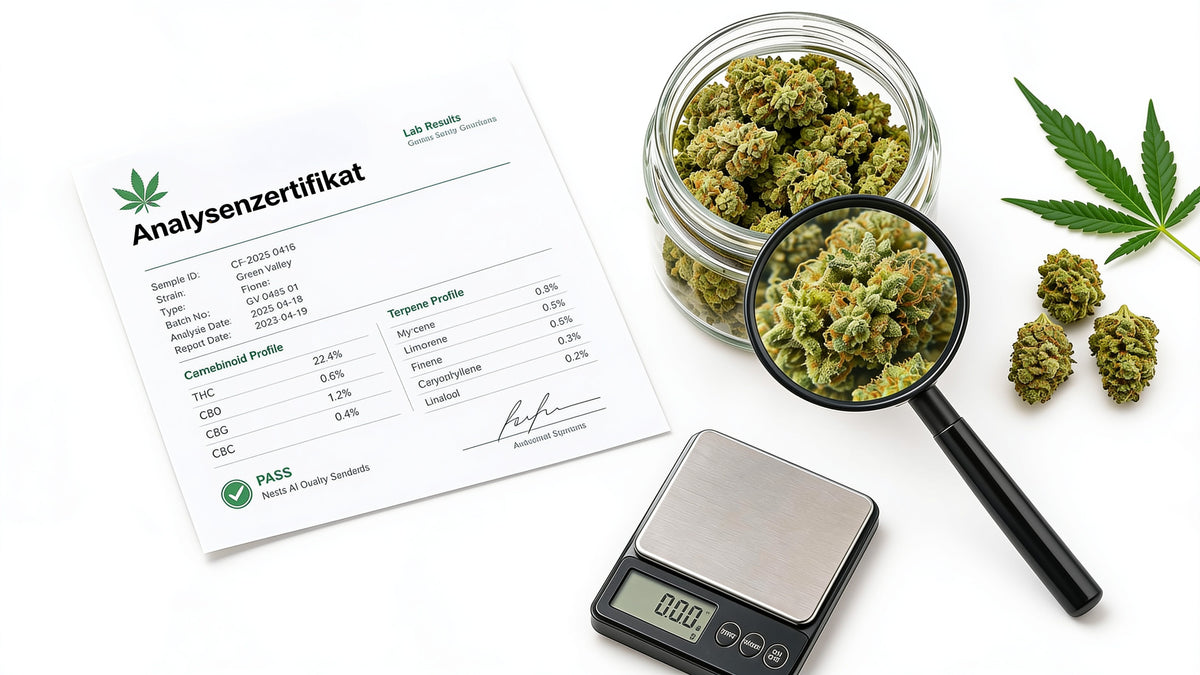
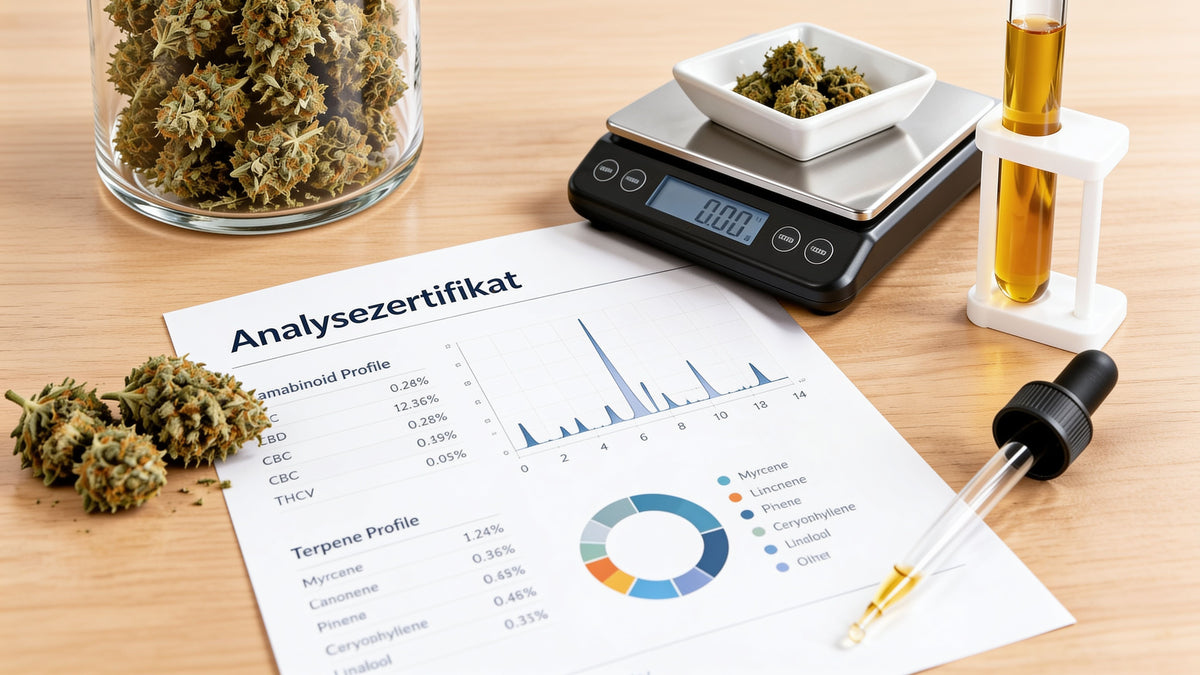
The most important thing for your safety is current and complete laboratory certificates , also known as Certificates of Analysis (COAs) . Think of this document as your product's personal bodyguard. It's irrefutable proof that everything is clean and there are no nasty surprises lurking inside.
Read lab certificates like a pro
A reputable provider like MYGREEN doesn't just hand out these certificates upon request, but proactively and transparently displays them directly on the product page. But what does this piece of paper actually tell you?
- Purity & Potency: Here you can see how much 10-OH-HHC is actually present. Values like "purity >99%" practically scream for an excellent, clean distillate.
- No heavy metals: Look out for lead (Pb), arsenic (As), mercury (Hg), and cadmium (Cd). These nasty substances must either be below the legal limit or marked as "ND" (Not Detectable).
- Pesticide-free: The certificate must clearly confirm that no pesticide residues were found.
- No solvents: Residues from the manufacturing process, such as heptane or ethanol, have no place in your product. The levels must be below the legal limits.
A Certificate of Analysis (COA) without a complete emissions analysis is like a sports car without brakes – it might look cool, but you definitely wouldn't want to drive it. A comprehensive, transparent certificate is the strongest indication that you're dealing with a true professional.
The following graphic serves as a kind of decision tree. It shows you the pitfalls and safe paths for buyers and sellers and helps you ask the right questions.
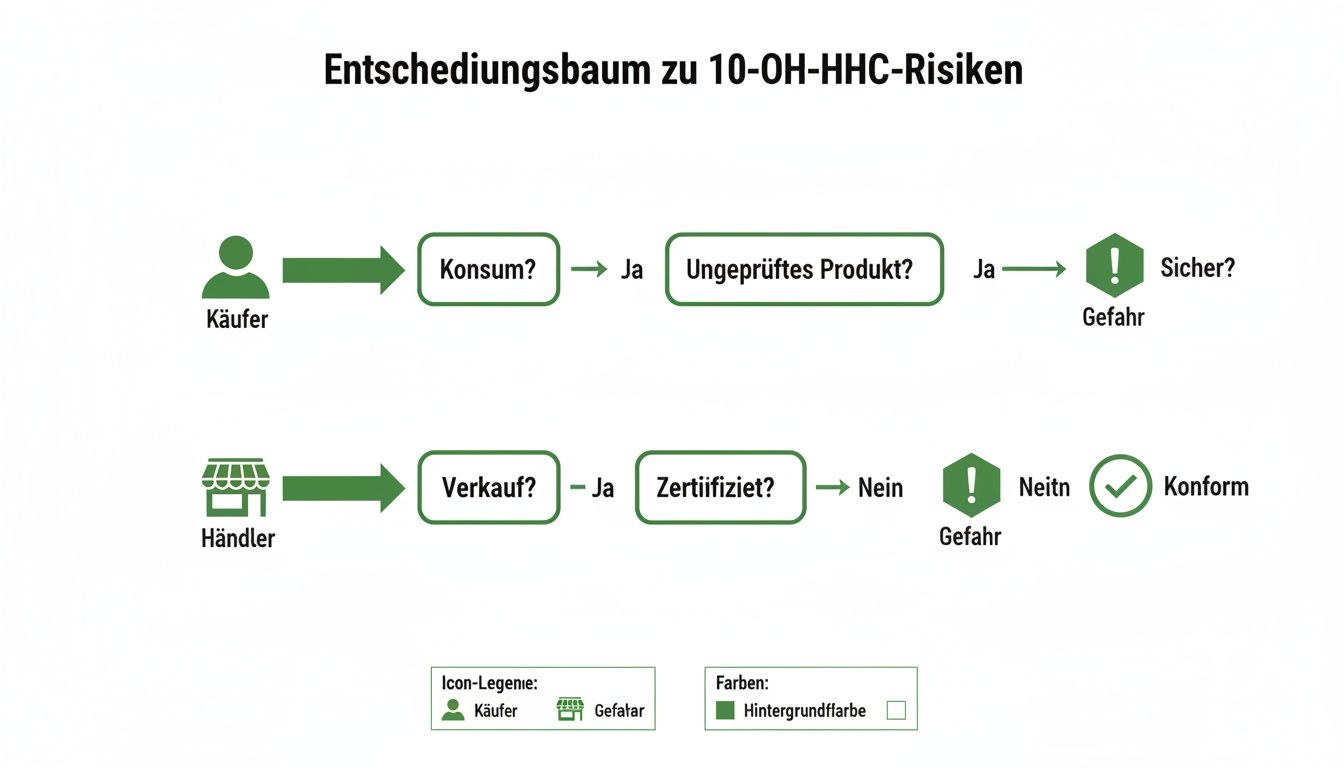
As the graphic nicely illustrates: The safest way for you as a buyer is always through verified quality and suppliers who have nothing to hide.
Other things you should keep an eye on
Besides the raw lab results, there are a few other indicators that distinguish a trustworthy shop. These "soft skills" help you separate the wheat from the chaff.
Here's a simple checklist to help you with your next purchase decision. It's your compass in the 10-OH-HHC jungle!
Checklist for a safe 10-oh-hhc purchase
A practical guide to distinguish reputable suppliers from unsafe ones and to assess the quality of a product.
| feature | What you need to pay attention to | Why it's important |
|---|---|---|
| Transparency & Accessibility | Is there a complete legal notice with a German address? Is customer service easily reachable and does it answer your questions about legality competently? | A "ghost shop" without a legal notice is a huge red flag. Being reachable builds trust and shows that the seller stands behind their products. |
| Real customer reviews | Look beyond the glowing 5-star reviews on the shop page. Find verified opinions on independent platforms. | Purchased reviews are easy to spot. Genuine experiences from other customers are invaluable and give you a realistic picture. |
| Product presentation | Do the products appear to be packaged in a high-quality manner and are they sealed? A professional presentation is often a sign of meticulous care behind the scenes. | Sloppy packaging often indicates sloppy production processes. Quality begins with the outward appearance. |
| Discreet shipping | Does the supplier promise neutral, odorless packaging without conspicuous logos that attract curious glances? | Your privacy is important. A good provider understands this and ensures that your package arrives discreetly, just like we do at MYGREEN with our "Ghost Delivery". |
With this checklist in hand, you are well prepared to make a safe and informed decision.
If you want to see what a transparent and customer-friendly offering looks like in practice, take a look at our carefully curated selection of lab-tested 10-OH-HHC products . This will make your foray into the world of legal cannabinoids a thoroughly positive and safe experience.
A brief look into the crystal ball: The future of 10-OH-HHC
Let's briefly recap where we stand: The big question, "Is 10-OH-HHC legal?" can currently be answered with a resounding "Yes." It's the perfect example of how the cannabinoid market works—a clever and swift response to the ban on its predecessor, HHC. But the whole thing feels a bit like a relay race, and one inevitably wonders: How long can the current runner maintain the pace before the baton needs to be passed?
Let's be honest: The legal window of opportunity for 10-OH-HHC will likely close at some point. The perpetual cat-and-mouse game between innovative manufacturers and lawmakers simply continues. As soon as a new substance appears on the scene and gains popularity, it inevitably lands on the radar of the authorities.
The next chapter in the law book
The next generation of cannabinoids is already waiting in the wings, often chemically only a tiny step away from their predecessors. It's therefore only a matter of time before German legislators once again invoke the New Psychoactive Substances Act (NpSG) to close the latest loopholes. Incidentally, the impetus for this often comes from Brussels, when the European Monitoring Centre for Drugs and Drug Addiction (EMCDDA) once again sounds the alarm.
So what does this mean for you? Quite simply: Enjoy your current freedom, but keep an eye on developments. The situation can change, and it's crucial to stay informed so you don't accidentally get left behind.
The future of the cannabinoid market has a name: responsibility. Suppliers who already insist on full transparency, comprehensive lab analyses, and top product quality are not only the safest choice for you; they are actively building a market that can withstand future legislative changes.
Providers like MYGREEN take this pioneering role very seriously. We set standards that go far beyond what the legislator currently requires. In doing so, we demonstrate what a sensible, safe market can look like and prove that legality and an outstanding product experience don't have to be mutually exclusive.
Our tip for your journey through the fascinating world of cannabinoids is therefore quite clear:
- Stay curious and informed: Follow the news about the legal situation. Don't rely on information from last week – it may already be outdated.
- Demand transparency: Only buy from retailers who proactively provide you with a complete laboratory certificate for every single batch. No certificate? Stay away!
- Trust in genuine quality: Choose shops that offer guarantees and fully stand behind their products – like us with our 30-day satisfaction guarantee .
The cannabinoid world will continue to evolve. But with the right knowledge and a partner you can trust, you'll always be one crucial step ahead.
Frequently Asked Questions (FAQ)
Okay, let's get down to brass tacks! Welcome to the final round of our deep dive. We've battled our way through the legal jungle, now it's time to get down to brass tacks. Here we'll answer the questions that are really on your mind – short, sweet, and without any legalese.
Can I drive a car after consuming 10-OH-HHC?
Let's not beat around the bush: A resounding, emphatic, and emphatic no! Sure, 10-OH-HHC isn't (yet) listed in the Narcotics Act. But that's completely irrelevant, because Section 24a of the Road Traffic Act (StVG) applies here with full force. It prohibits driving under the influence of any intoxicating substances.
Since 10-OH-HHC has a psychoactive effect, you are unfit to drive – end of discussion. Imagine you're drinking a super strong, unknown liquor. Just because it's not explicitly listed in the law doesn't mean you'd get behind the wheel, right? During a police check, the exact legal status of 10-OH-HHC is irrelevant.
The truly insidious aspect is the so-called cross-reactivity . The standard drug tests used in roadside checks aren't the most sophisticated – they look for THC metabolites. Because 10-OH-HHC is chemically related, there's a real risk that the test will simply give a false positive result.
And then what? Then it's off to the blood test. If the lab finds a psychoactive substance that impaired your ability to drive, it'll get really expensive. We're talking hefty fines, points on your license, and the revocation of your driver's license. Do yourself and others a favor: Leave the car at home.
How does the effect of 10-OH-HHC differ from that of HHC?
Many report that 10-OH-HHC has a noticeably faster kick and often feels more intense than its predecessor, HHC. This is due to a simple biochemical trick: 10-OH-HHC is essentially the "ready-made" version of HHC. It's already a metabolite, precisely the substance that your body would otherwise have to laboriously produce from HHC.
So you skip an entire processing step in the liver, and bam – the effects kick in much faster. While HHC has often been described as "the gentler THC," many users find the high from 10-OH-HHC to be clearer and more energetic mentally, accompanied by a deep, pleasant physical relaxation.
But as always, everyone is different. Your personal experience depends on your tolerance, the dose, and how you're feeling that day. The golden rule is therefore: always start with a small dose and gradually increase it. If you want to delve deeper into the subject, you'll find all the important details in our guide , "What is 10-OH-HHC ?"
What happens if customs intercepts my package containing 10-OH-HHC?
Take a deep breath – this worry is completely unfounded when ordering within Germany from a reputable provider like MYGREEN. Customs does not inspect domestic shipments. Your package will arrive directly, discreetly, and without any detours.
Things only become critical when you try to have products shipped from abroad. Even if a substance is legal here, customs can inspect packages from non-EU countries or even from some EU member states.
Should the authorities actually open the package, one thing is particularly likely: annoying waiting. They first have to check whether the contents are truly legal, and that can take a while. To save yourself this whole circus from the outset, there's a very simple solution:
- Always order from a shop that is based in Germany.
- Make sure that the shipment is discreet and without conspicuous logos.
At MYGREEN, we ship all packages lightning-fast from our German warehouse. Our "Ghost Delivery" service, using odor-neutral and completely anonymous packaging, ensures that your privacy is 100% protected and that your order arrives safely and without any hassle. This makes the question of whether 10-OH-HHC is legal purely theoretical for you – because your purchase is secure on every level.
At MYGREEN you'll find a huge selection of lab-tested 10-OH-HHC products that meet the highest quality standards. Discover our range now at https://shopmygreen.com and see for yourself our service – with discreet shipping, 24/7 support, and a 30-day satisfaction guarantee.
Article created using Outrank





10-OH-HHC effects and experiences: The honest guide
What is the real difference between THC and CBD?